When Should I Use a Single AI Agent Instead of Multiple Agents?
Start with one AI agent when one coherent context can solve the task. Split only for real parallel work, hard permission boundaries, or measured limits.
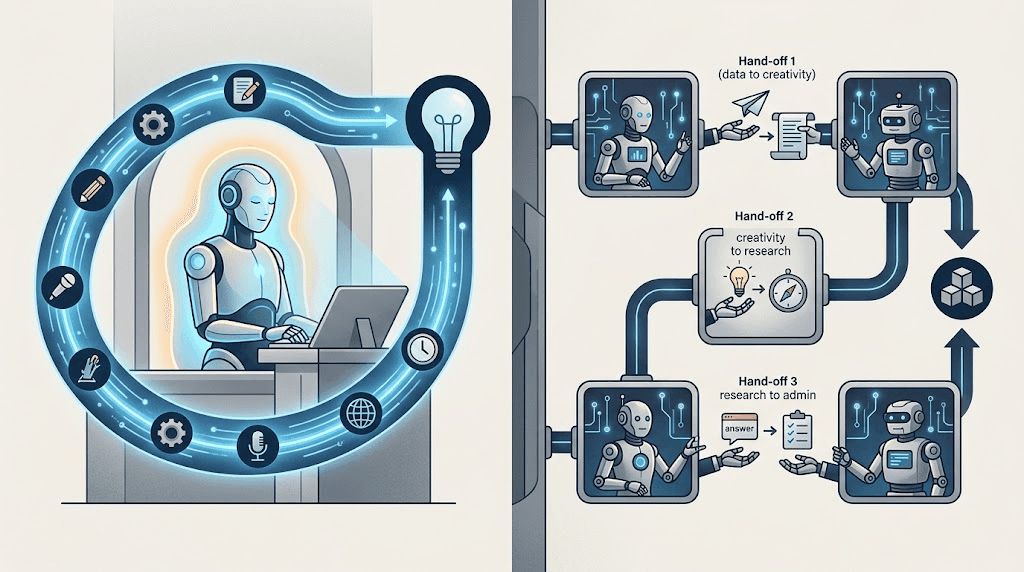
The number of agents is an architecture decision, not a maturity badge. Adding specialists can make a system easier to isolate and scale, but it also adds handoffs, state management, failure paths, and cost.
The safest default is simple: start with one agent, give it the smallest useful toolset, and measure where it fails. Split only when the evidence points to a problem that another prompt, better retrieval, clearer tools, or narrower permissions cannot solve.
The short answer
Use a single AI agent when the task has one coherent context, one accountable owner, and one loop of tool calls that can reach a verifiable outcome. It is usually the better starting point when speed, cost, debugging, and a unified view of the task matter.
Use multiple agents when at least one of these is real: independent work can run in parallel, separate agents must cross a security or organizational boundary, or one agent cannot keep the required context and responsibilities distinct after reasonable optimization. This is consistent with the guidance from OpenAI, Microsoft, and Google Cloud.
Do not split because a diagram looks more impressive, because the prompt has several role labels, or because “specialist” sounds more reliable. A multi-agent design earns its place by improving a requirement you can measure.
First, define what “one agent” means
“Single agent” does not mean “one model call.” It means one model-controlled worker owns the loop, keeps the working context, chooses among its allowed tools, and decides when to stop. The runtime can still enforce permissions, validate arguments, set turn limits, log events, and ask a human to approve a sensitive action.
OpenAI defines an agent around workflow control and dynamic tool use, while distinguishing it from a single-turn model call that does not control execution (OpenAI). A single agent can therefore perform several steps. It can search, inspect a record, call an API, verify a result, and ask for approval without becoming a multi-agent system.

The comparison is also not binary. There is a useful architecture ladder:
| What the workflow needs | Sensible starting point | Why |
|---|---|---|
| Predictable rules and fixed steps | Ordinary software | The path is known and testable without model-directed control. |
| One bounded interpretation step | One model call inside software | Language helps, but the program still owns the path. |
| Several known model-assisted stages | A fixed LLM workflow | Code owns the sequence; each step has a clear contract. |
| A changing path inside one coherent task | One agent with tools | One owner can choose the next check from the evidence it sees. |
| Independent branches, hard boundaries, or separate contexts | Multiple agents with explicit orchestration | The split has a concrete job and a measurable reason to exist. |
Anthropic makes the same broader point: start with the simplest solution and add complexity only when it demonstrably improves the outcome (Anthropic).
If you have not decided whether the workflow needs an agent at all, start with the AI agent decision framework. This article assumes that decision has already been made and focuses on the number of model-controlled workers inside the chosen system.
Use the SPLIT test before you split
The following is my synthesis of the trade-offs in the primary guidance. SPLIT is not an industry standard, benchmark, or claim of private testing. It is a forcing function for an architecture review.
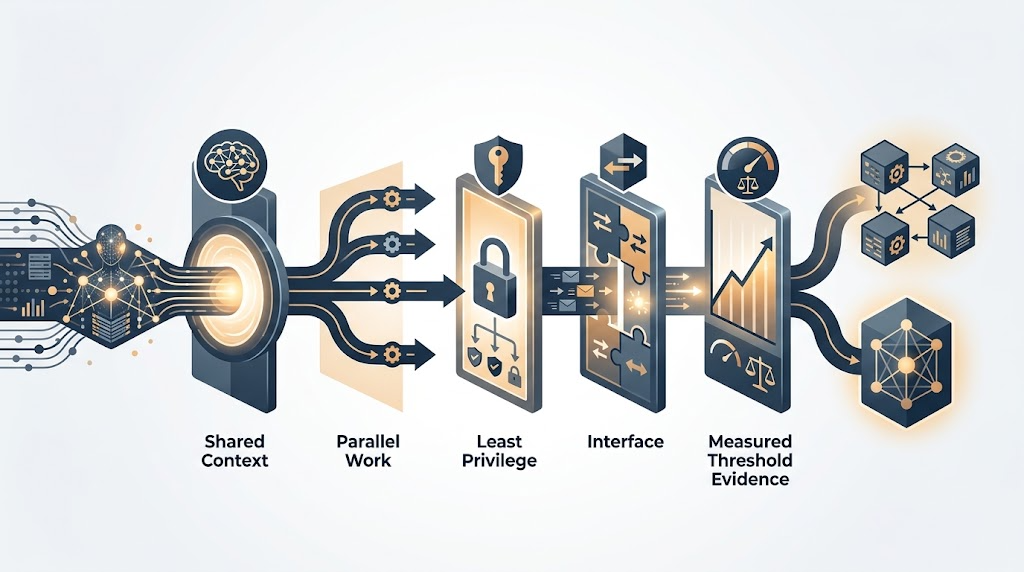
| Test | Question | Stay with one agent when... | A split becomes plausible when... |
|---|---|---|---|
| S: Shared context | Does the next decision require the full working state? | The same evidence, user goal, and history must remain visible to the decision maker. | Context must be isolated, exceeds practical limits, or contains incompatible data boundaries. |
| P: Parallel work | Can independent branches run at the same time? | Steps depend on one another or only one path is useful at a time. | Several branches can work independently and a deterministic or well-defined synthesis step can merge them. |
| L: Least privilege | Must different work have different authority? | One narrow permission set is enough and the agent can be safely constrained. | Policies require separate credentials, data zones, approval roles, or separation of duties. |
| I: Interface | Can each proposed agent have a crisp contract? | The proposed handoff would summarize away evidence or create ambiguity. | Each agent can receive bounded inputs and return a verifiable artifact, decision, or state change. |
| T: Threshold evidence | Has the one-agent baseline failed a defined requirement? | You have only a feeling that the system is too complex or “needs specialists.” | Repeated tests show a persistent failure after tool, retrieval, prompt, model, and policy improvements. |
The rule is deliberately asymmetric. A “yes” in Shared context or a “no” in Interface is a strong reason to stay single. A “yes” in Least privilege can justify a split before optimization because the boundary is architectural, not cosmetic. A “yes” in Parallel work matters only if the branches are truly independent and the merge cost does not erase the speed gain.
When a single agent is the right choice
One person or system owns the outcome
Keep one agent when the task has one goal and the next action depends on the same evolving evidence. Support triage is a common shape: inspect the customer message, check account state, look for relevant policy, decide what is missing, and draft or propose the next action.
Passing that task through a researcher, policy agent, account agent, and response agent may look tidy. But every handoff can compress the original evidence. If the final decision depends on the exact wording of the request, the account state, and the policy exception together, one owner with well-defined tools may be easier to reason about.
This is not a claim that one agent always performs better. It is a maintainability rule: if the decision is unified, preserve the context until measurement proves that context separation helps.
The work is sequential, not parallel
If step two cannot start until step one produces a result, multiple agents do not automatically create speed. Google Cloud distinguishes sequential and parallel patterns and notes that parallel execution is useful when subtasks are independent; it also warns that parallel systems add resource use and synthesis work (Google Cloud).
For a sequential task, a single agent may still need a bounded workflow around it. The runtime should record tool calls, validate inputs, and stop on errors. But the model-controlled worker does not need to become a committee simply because the task has several steps.
You are still discovering the real failure
Start with one agent when you do not yet know whether the problem is the model, the tools, retrieval, permissions, or the workflow itself. A baseline gives you one trace to inspect. A premature multi-agent system gives you a distributed trace before you know which behavior matters.
OpenAI recommends adding tools incrementally and maximizing a single agent before introducing more agents. It points to complicated instructions and persistent incorrect tool selection as signals that a split may be useful, not as proof that a split is required (OpenAI).
Cost, latency, and operational simplicity matter
Every additional agent brings its own prompt, context construction, tool permissions, evaluation cases, monitoring, and failure handling. Microsoft describes extra handoff latency, state synchronization, security surfaces, and communication overhead in multi-agent systems (Microsoft).
The exact cost depends on your provider and workload. Do not copy a vendor's number into your business case. Measure your own baseline with the same representative tasks, model settings, and tool environment you would use in production.
When multiple agents earn their place
A real security or compliance boundary exists
Use separate agents when the work must cross a boundary that one identity should not cross. A transaction-preparation agent may need to propose a change while a separate validator, service, or human approval path must authorize it. A customer-data agent and a public-web research agent may need different data access and retention rules.
Microsoft calls out security and compliance boundaries, including separation of duties, as reasons to start with multiple agents. It also warns that more agents create more credential and data-transit points to govern (Microsoft).
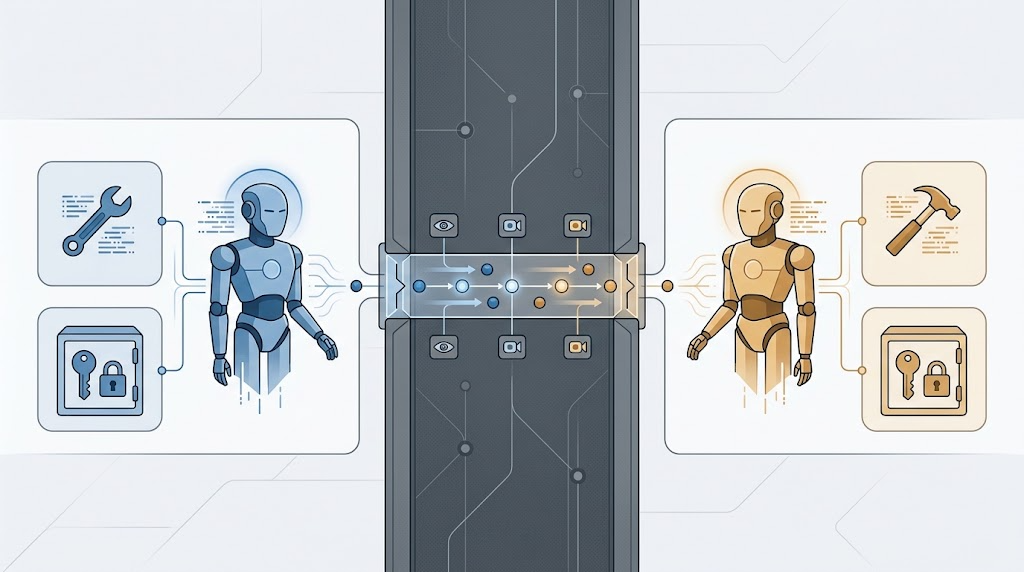
The important nuance is that “different roles” and “different permissions” are not the same. You can often express a reviewer role inside one agent's workflow. You need a separate architectural boundary when the reviewer must not share the executor's authority, context, or identity.
Independent work can run in parallel
Parallelism is the cleanest performance reason to use multiple agents. Imagine a research request that asks for independent evidence from several domains. Separate workers can search their assigned direction at the same time, then a lead process can reconcile the findings.
Anthropic reports this as the strong case for its multi-agent research system: breadth-first queries with independent directions benefited from parallel exploration and separate context windows. The same report says the approach uses substantially more tokens and is a poor fit for work with many dependencies, so treat it as an attributed vendor result, not a universal benchmark (Anthropic).
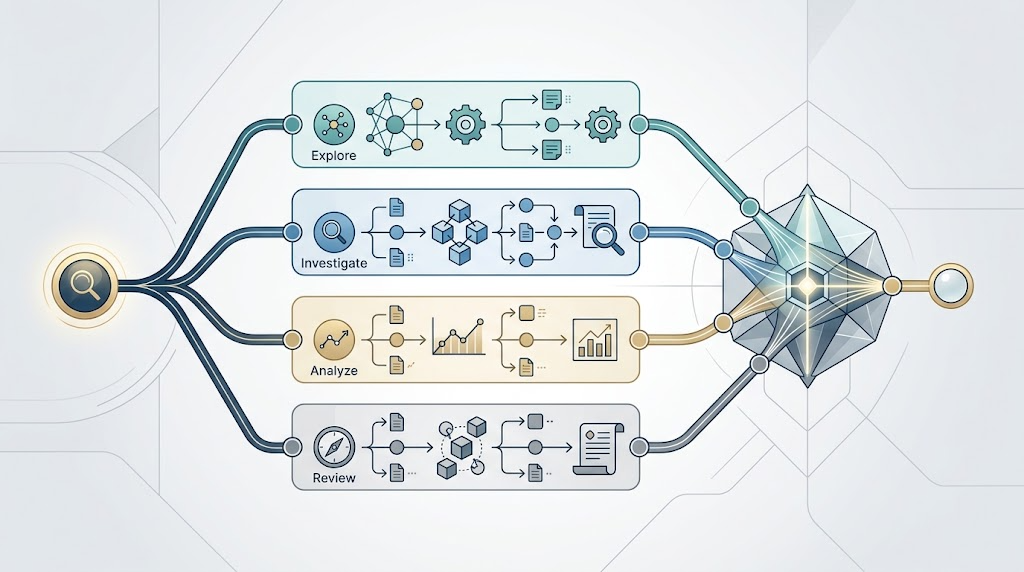
Before choosing this pattern, answer three questions:
- Can the branches start without waiting for each other?
- Can the merger identify conflicts instead of averaging them away?
- Is the value of faster or broader coverage greater than the extra calls, synthesis, and review?
If any answer is no, begin with one agent or a fixed parallel program with ordinary workers rather than adding autonomous agents.
The work needs durable specialization with stable interfaces
A split can help when different domains have genuinely different tools, policies, context, or release ownership. The case is strongest when each specialist can be treated as a component with a narrow contract, not as a persona in a shared conversation.
For example, an internal finance agent might return a validated accounting record, while a customer-support agent returns a proposed explanation. The orchestrator does not need the finance agent's entire working context. It needs a typed result with provenance and an explicit failure state.
Google Cloud describes this as context engineering: each specialized agent receives the documentation, history, links, and constraints needed for its task, while the system manages information flow between boundaries (Google Cloud). If you cannot say what context crosses the boundary and how the receiver verifies it, you have not designed a component. You have created a second prompt.
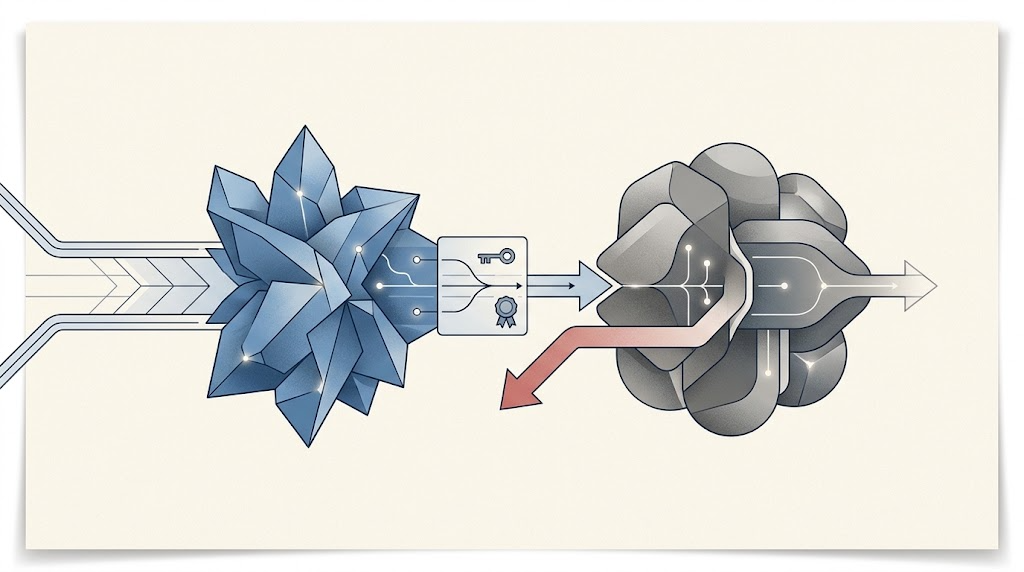
A single agent has a measured, persistent limit
A long prompt is not a diagnosis. Too many tools may mean the tool descriptions overlap. A growing history may mean retrieval or context selection is poor. A “planner, reviewer, and executor” design may work inside one agent with conditional policies.
Split only after the baseline has been improved in the obvious ways: make tool names and parameters unambiguous, reduce irrelevant context, improve retrieval, gate permissions, and test a capable model. Microsoft recommends moving to multiple agents only when limitations persist after this kind of optimization (Microsoft).
The exception is a hard boundary. You do not need to prove that a single identity can be made secure if policy says it must not have both powers.
Weak reasons to create multiple agents
Several popular arguments are really requests for better system design:
| Tempting reason | Better first move |
|---|---|
| “The prompt has too many roles.” | Remove conflicting instructions, use policy variables, and test one agent with context gating. |
| “There are many tools.” | Group tools by task, improve descriptions and parameters, and record incorrect selections. |
| “The context is large.” | Fix retrieval, chunking, ranking, and context selection before assuming you need more agents. |
| “A critic will make the answer safer.” | Define a concrete verification contract. A critic that sees the same weak evidence may only add another confident opinion. |
| “Specialists sound more expert.” | Specify the boundary, input, output, and measurable benefit of each specialist. |
| “The system should scale later.” | Prototype the core path, then split where future ownership or permission boundaries are real. |
The vendor guidance is unusually consistent here. OpenAI says a single agent with tools is often sufficient and recommends splitting when complicated instructions or incorrect tool choices remain a problem. Microsoft says role separation alone does not justify multiple agents. Anthropic says to add complexity only when simpler solutions fall short (OpenAI, Microsoft, Anthropic).
Implementation artifact: compare the baseline before you split
Fill out this worksheet for the same task set. It is designed to force an architecture decision from evidence rather than preference.
| Field | Single-agent baseline | Proposed multi-agent design |
|---|---|---|
| Task and success condition | ||
| Source of truth for the final outcome | ||
| Tools and permissions | ||
| Context each decision needs | ||
| Independent branches | ||
| Handoff input and output contract | ||
| Forbidden actions and approval points | ||
| Median and worst-case latency | ||
| Model calls, tool calls, and token use | ||
| Outcome failures | ||
| Policy or permission failures | ||
| Human review burden | ||
| Debugging and replay path | ||
| Owner after launch | ||
| What would make us revert? |
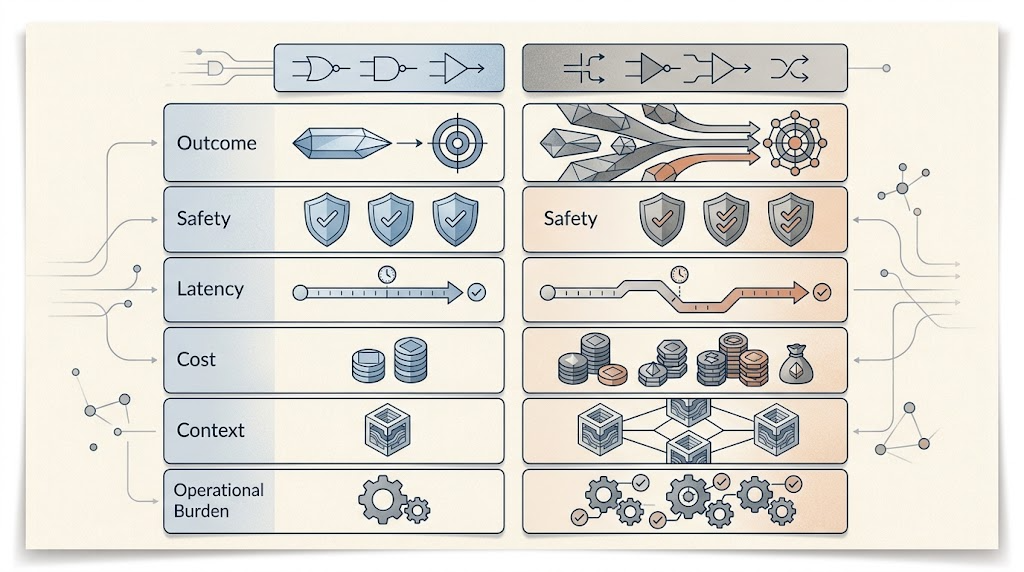
Run the comparison in this order:
- Freeze the task set, model configuration, tools, permissions, retrieval settings, and code revision for both candidates.
- Define pass and fail before looking at results. Include the final state, forbidden actions, required approvals, and operating limits.
- Run enough representative cases to expose normal work, missing information, conflicting information, tool failures, and out-of-scope requests. The exact count is a design choice, but it must be justified by the risk and variability of the workflow.
- Record the trace and the environment state. Grade what changed, not only what the final message claimed.
- Compare the dimensions that matter to the business: outcome quality, safety, latency, cost, repeatability, and operational effort.
- Choose the simplest design that clears the release threshold. If neither design clears it, the answer is not “add more agents.” Fix the requirement, tool, data, or safety boundary.
This protocol is an implementation recommendation, not a claim that I ran the tests for you. It also keeps architecture testing separate from production monitoring. For the latter, use the AI agent monitoring guide; for pre-release evaluation, use the AI agent release gate.
Three hypothetical decisions
Customer support with account actions
Start with one agent if it needs to read the conversation, inspect account data, and propose a response. Add a separate agent or service boundary if the system must submit a refund while a different identity validates eligibility and approval. The reason for the split is least privilege, not the fact that support and finance have different job titles.
Open-ended market research
A single agent may be adequate for one focused question with a small evidence set. Multiple agents become plausible when the request contains several independent research directions, the work can run concurrently, and a synthesis step can preserve citations and surface conflicts. Anthropic's research system is a first-party example of this pattern, with the limitation that its costs and performance do not transfer automatically to your workload (Anthropic).
A coding workflow with planner, implementer, and reviewer labels
Do not split on labels alone. First test one agent with clear tools, a bounded repository, a patch-review step, and a source-of-truth test suite. Split when the reviewer must have a genuinely different authority or context, or when measured parallel work improves the result. A second agent that repeats the first agent's assumptions is not independence.
The decision in one sentence
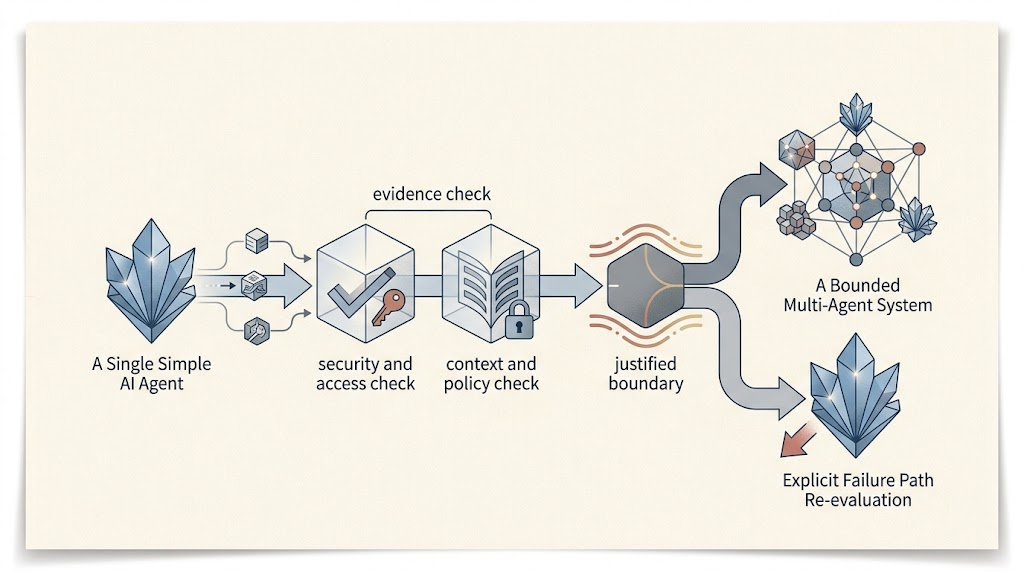
Use one AI agent when one coherent context and one accountable loop can solve the job. Use multiple agents only when a hard boundary, real parallelism, or a measured context and specialization limit makes the split worth its coordination cost.
If you are building the first version, keep the single-agent trace easy to inspect. If you are proposing a multi-agent version, write down the boundary, the interface, the merge rule, and the metric that pays for the extra moving parts.
If a team is stuck between the two designs, a bounded architecture review or evaluation workshop is a sensible next step. It is useful when the team already has a concrete workflow, representative cases, and access constraints to inspect. It is not a substitute for defining the business outcome or for specialist legal and security advice. You can also start with Marius Manolachi's AI consulting work if you need help framing that review.